
The Exercise Ladder: step by step toward what you avoid
Health anxiety makes you avoid medical shows, trips or talk of illness? With the Exercise Ladder in Pausewave, you move toward it in small steps you choose.
Anxiety about your health often changes everyday life quietly. You switch channels when a medical drama comes on TV. You put off the trip because there's no familiar doctor at your destination. You check your body every evening, reread old test results, ask your partner for the third time whether she really doesn't see anything. Each seems reasonable on its own. Together, they make life smaller.
The Exercise Ladder in Pausewave is a tool for making that circle bigger again, step by step. Voluntarily, at your own pace, and with one clear rule: an exercise counts as done when you've done it, not only once the anxiety is gone.
The idea behind the ladder
Anxiety often grows when we avoid what triggers it. If you face it step by step and of your own free will, you have new experiences: that fears often don't come true, and that you can stay with anxiety, even without checking.
That's why you build yourself a ladder: at the bottom, exercises that cause a little anxiety, at the top, the hard ones. You start at the bottom. Once you've done a step a few times and notice you can stay with it, you can move on. Whether you move on is up to you. The app doesn't lock anything.
How to build your ladder
In the Practice tab, choose Exercises at the top. Under "How the ladder works" you can reread the rules.
- Your goal: "What would you like to be able to do again, even if the anxiety comes along?" For example: "Go on vacation relaxed again."
- Choose steps: From the catalog or as an Own exercise. 5 to 10 steps are a good start.
- Rate the anxiety: For each step, you estimate how much anxiety it would cause, from 0 to 10. The app sorts the steps by that, and you can change the order. It suggests starting with a step that causes about 2 to 4 out of 10.
The catalog has 44 exercises in seven areas: Reduce checking, Reduce reassurance, Reduce avoidance, Bring on body sensations, Words and texts about the illness, Travel and holidays without checking, and Without aids and without the app. Examples are "Delay the search by 30 minutes", "Halve the checks", "A medical series or a film" or "Don't postpone the trip". The anxiety number in the catalog is only a typical range. Your own estimate is what counts.

Doing an exercise
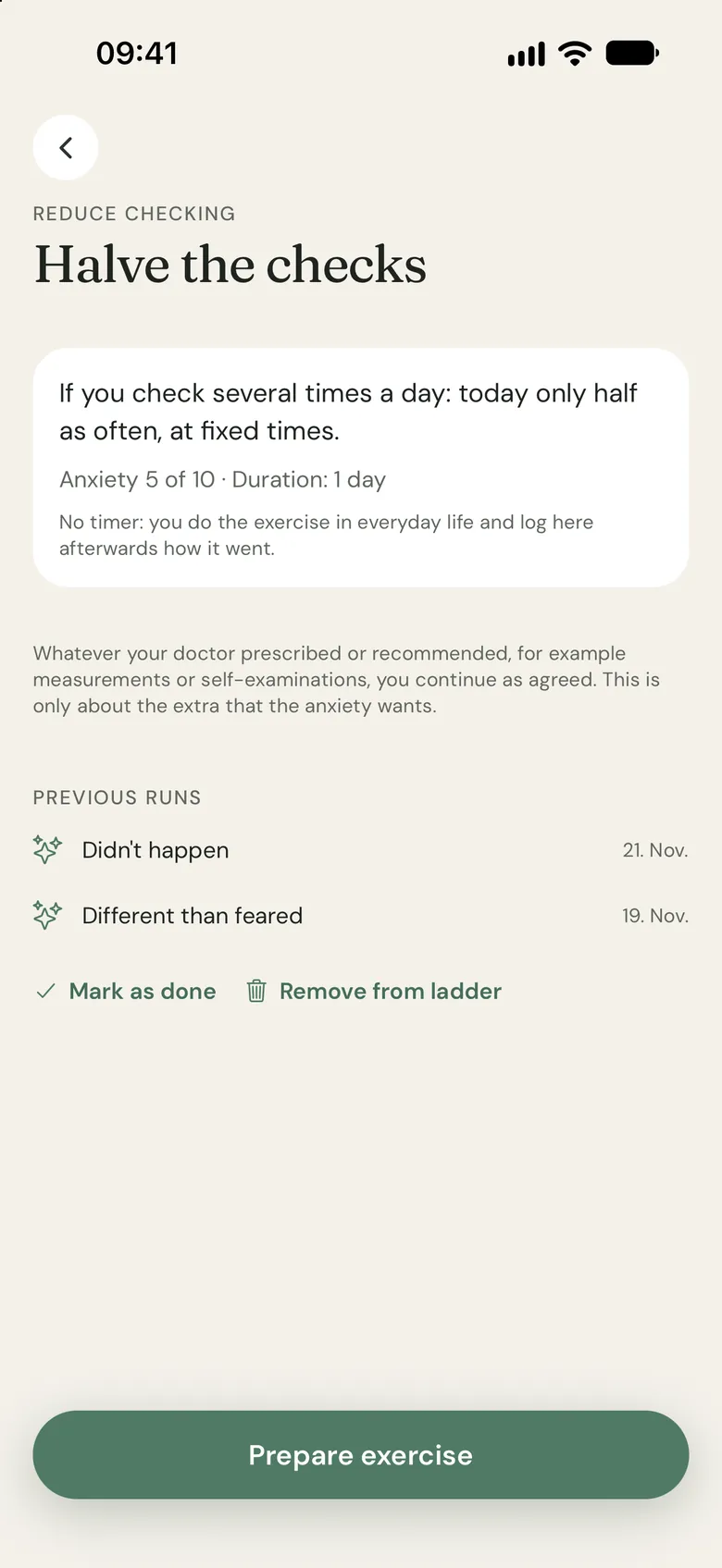
When you tap a step, you see your past runs and "Prepare exercise".
Before, the app asks: "What do you fear will happen?", with suggestions like "I won't last until the end". Optionally: how sure you are that it will happen, and how much anxiety you feel right now. If you've done the step before, it also asks: "What are you doing differently this time?" Below that is the most important rule: during the exercise, don't check, don't ask, don't reassure yourself. The anxiety is allowed to rise. It doesn't have to be gone for the exercise to count.
During the exercise, a timer runs with the same wave as in Wait It Out. Everyday exercises, such as "A day without symptom searches", run without a timer: you do them and note afterwards how it went. Instead of a big emergency button, there's "Pause" with two options: "Acute Help: breathe for a moment" or "End exercise". Using help is allowed. The app notes it so you can later see what you already manage without it.
Afterwards, you ask yourself: Did it turn out the way you feared? Were you able to stay with it? Did you play it safe along the way, by reassuring yourself, distracting yourself or checking? And, if you like: What did you learn?
Moving on, repeating, varying
After a few runs, the app shows you how your expectation has changed, for example: the first time you were 70 % sure, most recently 30 %. Then it asks how you'd like to continue: Next step, Again, but differently or Again. "Differently" means a different place, a different time of day, a little longer. That way, what you learn doesn't only apply to one situation.
The app shows the highest anxiety per run for information only, never as a condition. If a fear did come true, that's honest information too. Maybe the step is still too big, and an in-between step would help.
Exercises with body sensations
One area of the catalog deliberately brings on everyday body sensations, for example "Up the stairs" or "Warm room". These exercises aren't meant for everyone. Before you see them, Pausewave asks a short list of questions once, for example about a pregnancy or conditions for which you've been advised against exertion. If something applies or you're unsure, these exercises stay hidden. You use all the others as usual. Your answer stays on your device, and you can change it in the settings.

Free and with Pro
The Exercise Ladder is part of Pro. You can look through the catalog without Pro, and one exercise is free: "Wait out an urge without the app". It suits anyone who knows Wait It Out and would like to try it once with no tool at all.
Limits
The Exercise Ladder doesn't replace psychotherapy. If you're in psychotherapy, it's best to talk your ladder over there. Anything your doctor prescribed or recommended, such as measurements or checkups, you keep doing as agreed. This is only about the extra that the anxiety wants.
Frequently asked questions
How many steps do I need?
5 to 10 are a good start. You can add, mix or skip steps later.
What if I stop an exercise early?
Then you started, and that counts. Maybe the step was too big today. A smaller one is just as much practice.
When is a step done?
When you've done it a few times and notice you can stay with it. The app suggests the next step, and you decide. You can also mark a step as done yourself.
Does the anxiety have to go down during the exercise?
No. An exercise counts when you've done it. Whether the anxiety rises, stays the same or goes down, it's all practice.
Sources
- Craske et al. (2014): Maximizing exposure therapy. An inhibitory learning approach. Behaviour Research and Therapy
- Walker & Furer (2008): Interoceptive exposure in the treatment of health anxiety and hypochondriasis. Journal of Cognitive Psychotherapy
- Rachman, Radomsky & Shafran (2008): Safety behaviour. A reconsideration. Behaviour Research and Therapy
- Abramowitz & Moore (2007): An experimental analysis of hypochondriasis. Behaviour Research and Therapy
Pausewave is a self-help app and not a medical device. It doesn’t diagnose anything and doesn’t replace a medical checkup. New or persistent symptoms belong with a doctor.


