
Understanding health anxiety: 12 short lessons in Pausewave
Why checking only calms you briefly and what waiting it out means: the 12 lessons in Pausewave explain health anxiety in short cards, with practice in between.
Many people who worry a lot about their health go a long time without having a name for it. They just know that one body sensation is enough to tip a whole day, and that checking never helps for as long as they wish it would.
It helps to know the pattern behind it. That's why Pausewave has a program of 12 lessons, each about five minutes long. In short cards, they explain how the cycle of worry and checking works and why waiting it out matters so much in the app.
Where to find the lessons
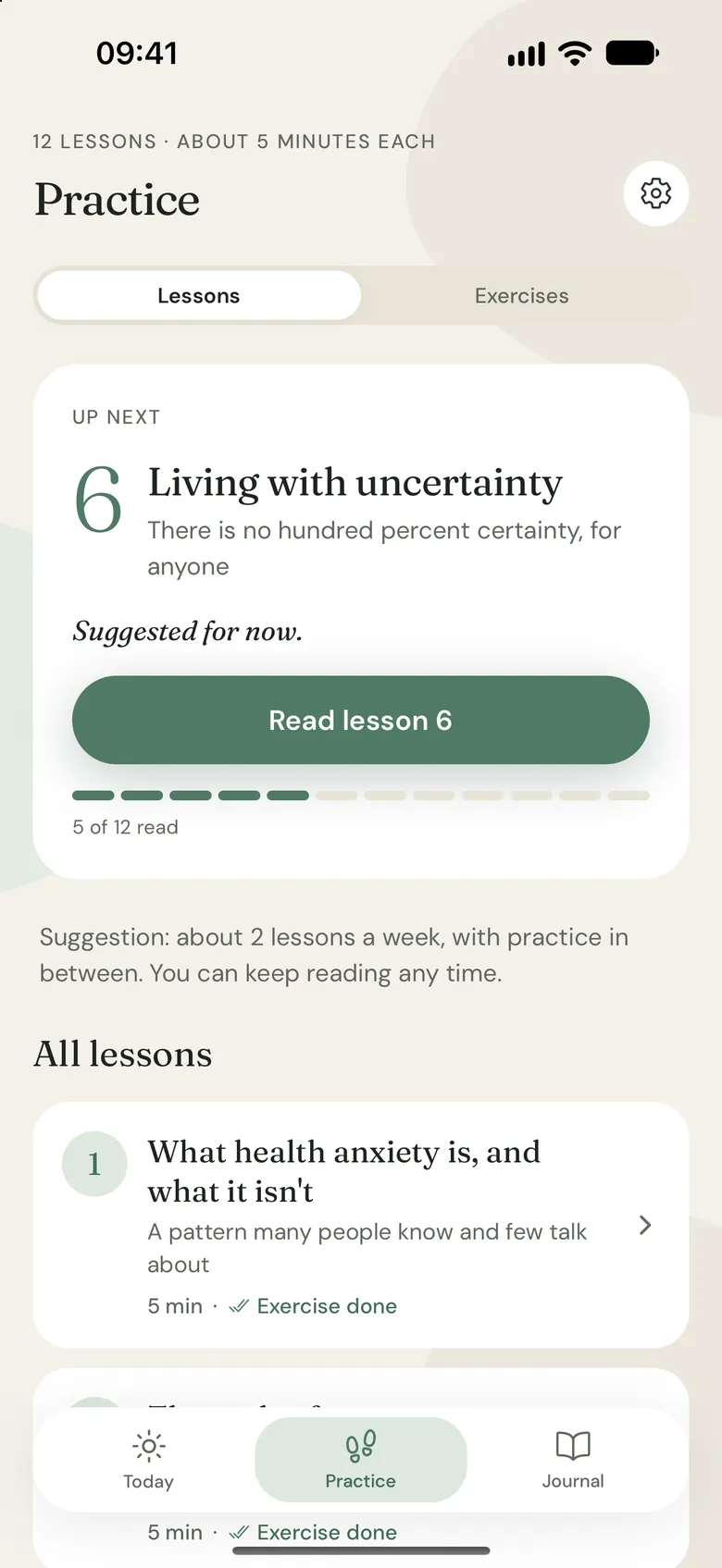
In the Practice tab, choose Lessons at the top. Right at the top you'll see what's up next, below that the suggested pace and the list of all lessons with their status: Not started, Started, Read · exercise open or Exercise done. On Today, Pausewave also shows you the suggested next lesson.
The 12 lessons
- What health anxiety is, and what it isn't
- The cycle of worry
- Where attention goes
- Why checking only calms you briefly
- Waiting instead of checking
- Living with uncertainty
- Examining thoughts instead of believing them
- Step by step toward the fear
- Doctors and medical tests
- Living with your body
- What matters
- Hard days, travel and setbacks
The first five form a block of their own: they explain the pattern and the reasons for waiting it out. From lesson 6 on, the lessons cover uncertainty, thinking patterns, the Exercise Ladder, how to handle doctor's visits, living with symptoms that stay, and what matters to you.
How a lesson works
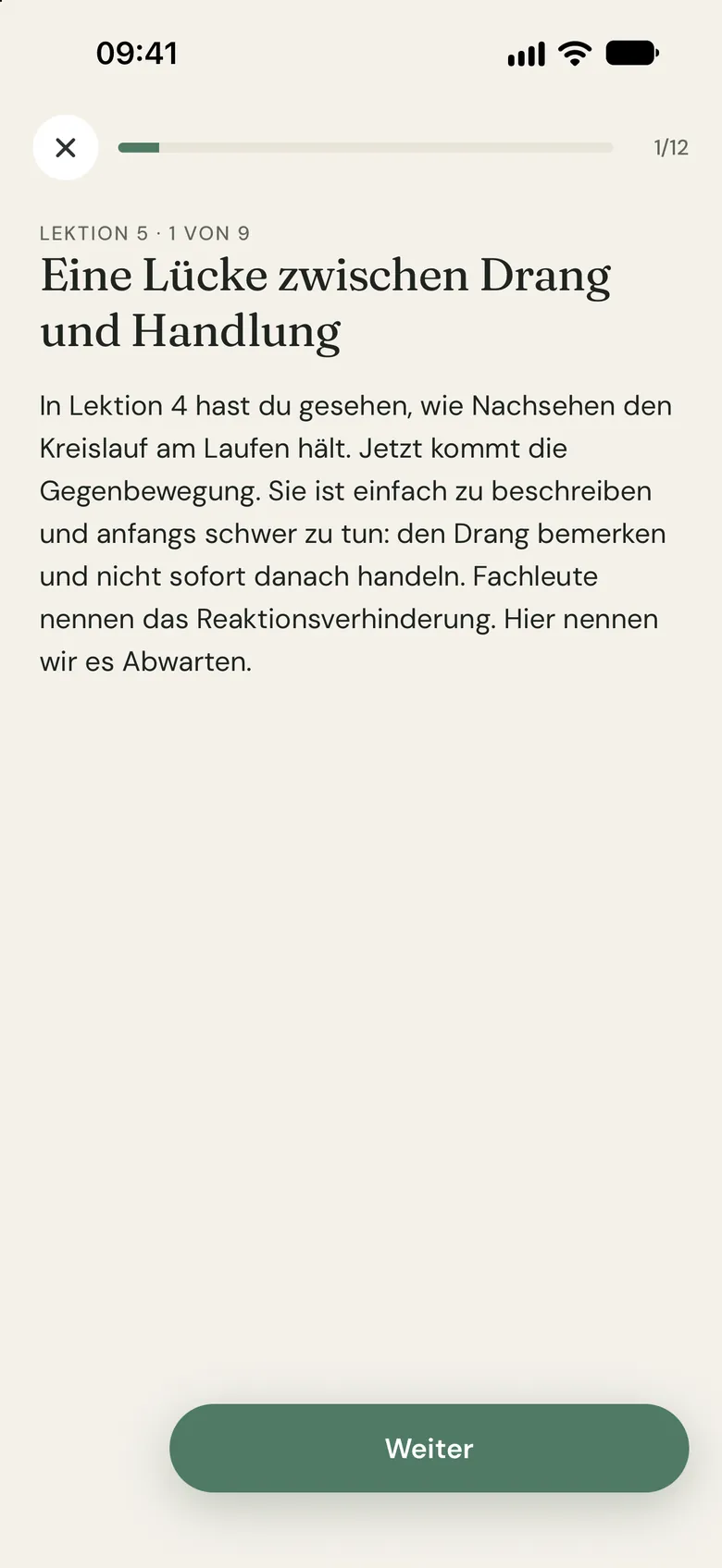
A lesson is made of six to ten cards that you swipe through. A progress bar at the top shows where you are. You can mark individual cards with "Save for later", and they're then collected at the end of the lesson. Some cards can be shared, for example a text for loved ones in lesson 11.
At the end of every lesson, a few fixed parts are waiting for you:
- Exercise until the next lesson: a concrete task for the next few days, often with a direct link, for example "Start Wait It Out", "Go to Exercise Ladder" or "Write down a worry". Once you've done it, tap "Exercise done".
- To reflect on: a question with a text field. Your answer stays only on your device.
- From my experience: in many lessons, a short personal text from the founder, who knows worries about his own health firsthand.
- Sources: the content puts the research literature into its own words. You can expand the sources. The sentence below them belongs there too: this app is not therapy.
- "Something not right?": here you can report a mistake or a passage that isn't clear.
Better slowly: about 2 lessons per week
Pausewave suggests about two lessons a week, with practice in between. The reason is simple: knowledge alone changes little if you don't try it out in everyday life. So the exercise at the end of a lesson isn't an add-on. It's the part that really matters.
Even so, nothing gets locked because of the pace. If you want to keep reading, you keep reading. The app only lets you know that the exercise from the last lesson is still open. You can turn that note off in the settings under "Lesson pace". If you like, you can also get a Lesson reminder: after three days a note about the next lesson, and after seven days, once, "Pick up again?". It's off by default.
A quick check-in
After lesson 5, after the last lesson and then about every four weeks, Pausewave asks: "How are things going with the app?" The answers are Easier, The same and Harder. There's no score and no analysis, and your answer stays on your device. If you choose "Harder", the app shows you who you can turn to and the way to the crisis numbers.
Free and with Pro
Lessons 1 to 5 are free, so the whole block that explains waiting it out. From lesson 6 on, you continue with Pro.
What the lessons are not
The lessons are self-help. They don't make a diagnosis, and they don't replace a medical evaluation or psychotherapy. If you're in psychotherapy, you can bring the content up there. Lessons 9 and 10 explain how doctor's appointments and lasting symptoms fit into this picture, without you having to choose between your anxiety and getting things checked.
Frequently asked questions
How long does a lesson take?
About four to six minutes. You can stop at any time and pick up later at the same spot.
Do I have to read the lessons in order?
The order is recommended because the lessons build on each other. But no lesson you have unlocked is locked.
What languages are the lessons available in?
Pausewave is available in ten languages, and all content, including the lessons, is available in each of them.
Who wrote the lessons?
The content is based on the research literature on self-help, and the sources are listed in every lesson. Many lessons also include short texts drawn from the founder's own experience.
Sources
- Salkovskis & Warwick (1986): Morbid preoccupations, health anxiety and reassurance. Behaviour Research and Therapy
- Weck, Richtberg & Neng (2014): Epidemiology of hypochondriasis and health anxiety. Current Psychiatry Reviews
- Bleichhardt & Hiller (2007): Hypochondriasis and health anxiety in the German population. British Journal of Health Psychology
- Bleichhardt & Weck (2019): Kognitive Verhaltenstherapie bei Hypochondrie und Krankheitsangst. Springer
- NHS: Health anxiety
Pausewave is a self-help app and not a medical device. It doesn’t diagnose anything and doesn’t replace a medical checkup. New or persistent symptoms belong with a doctor.


